

If I had a dollar for every time my husband has checked the stats on the weather in the last year, we could put a good dent in paying for my daughter’s future college tuition. He checks it while riding in the car, while standing in line at the store, even breaking the rules of no cell phones while in the movie theater. Most mornings I arise to find him already finished with his Bible reading and studying the weather reports in hopes of plotting a solid plan for the day: Is it going to rain? If so when? How strong are the winds blowing and from what direction? What is the expected temperature? How does this affect my goals for the day?
When we first got married I was quite naïve about the realistic workings of true farm life. I used to try to “plan” out our weekends. Those failed attempts quickly ended in lots of frustration until I finally had enough experience to believe that when my husband says “he doesn’t know” what he will be doing tomorrow…much less next week or next month, he’s being accurate. The unpredictable weather dictates so much of our lives in terms of successfully raising crops and livestock and let’s face it…we live in North Carolina. The beautiful Land of the Pines where there can be 3 inches of snow on Christmas and close to 70 degrees on New Years Day. True story.

Weather is our greatest unknown in the circle of life on a farm. We have the ability to test and amend our soils to have the right amounts of nutrients. We can use selective breeding to improve the genetics of the seed stock. We can lock in prices for commodities and purchase items such as fuel in advance if we know we can get a “good” price. But…do we know for certain the exact number of hurricanes, the intensity, and the dates of landfall we may have this coming season? No. Farmers cannot sign a contract that would guarantee the perfect weather forecast. So no wonder at 6:45am when I’m knee-deep in my closet trying to determine what I need to wear for the day I have my husband, the King Farm meteorologist, to ask. It’s a nice “luxury” I guess for a farmer’s wife. I’ve lost count of the times he has grabbed a rain jacket to toss in my car as I pull out of the garage. He’s usually right (don’t tell him I said this) when he say’s “don’t forget you have it…you’re going to need it when you leave work today.”
So let me share with you some of the more specific reasons we frequent the weather channel in our home:
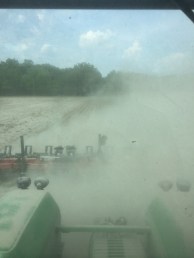 Not Enough Rain: This is the easiest to explain. There must be ideal moisture in the soil for seeds to germinate. For some crop applications rain is necessary to wash in fertilizer good into the soil to make it more readily available to the plant. If the plant is parched during the heat of the Summer it will not have enough moisture for seed progression and the final crop will be less volume.
Too Much Rain: Just as seeds need water to germinate too much water will cause them to rot before ever piercing the surface. This causes farmers no choice but to spend precious time and money to replant parts of fields. Crops can sit and rot in the fields after reaching the end of the life cycle (think dried out dead looking stalks of corn in September). If rain continuously sits on a crop when it is finished growing it creates a haven for mold growth and sometimes the seeds can actually regerminate while still attached to the plant. In the Fall of 2015 this was a common problem for cotton and soybeans. Once this happens whole truck loads of grain can be turned away because it is not usable.

Actual sample of our damaged soybeans from November 2015 from too much rain.
Rain at the “right” or “wrong” times: Ever tried to mow thick grass in early morning after a heavy dew or right after it rains? It makes an awful mess of the lawn mower and the yard. It dulls the blades and is actually bad for the plant. Combines can compare in the same way with row crops. There is a relatively small window of opportunity to get in the field and harvest the crops when the moisture content of the plant is acceptable to be sold.
Last week my husband applied a chemical to eradicate weeds. The label said it needed an hour of contact time on the leaves of the plant for it to do it’s job correctly and provide protection – and should be applied to dry leaves. Any guesses what happened thirty minutes later? Yep. A small little rain cloud made up right above them and he had to tack on another few hours to the workday.
Huge pieces of farm equipment like trucks, combines, and tractors can get stuck and bogged down if the soil is too wet also. Nothing like having the harvest ready but sitting on the sidelines waiting for it to dry out.


The hubby has stuck quite a few pieces of equipment over the years.
Too Windy: Farmers at times must go through the fields to apply fertilizers and chemicals that protect the crops from disease, weeds, and insects. Certain weeds like the dreaded Pigweed can ruin a crop of soybeans in a matter of weeks if not controlled on time (see photo below). If the wind is too strong it can negatively affect the drift application and make your attempt ineffective. Sometimes the wind can be your best friend however because of its ability to assist with drying down wet crops.
A field of soybeans overran by the weed commonly referred to as Pigweed. The weed grows so quickly it reseeds rapidly and sucks nutrients and water away from soybeans while also shading out the beans slowing down photosynthesis.
Too Hot: A few Summers ago the middle of July came a blistering heat wave. It was miserable temps close to 100 just at the time that the corn was at the stage of pollination. The heat wave was so intense that it scorched the fragile plant parts necessary to pollinate. Low pollination results in ears of corn that won’t fill out plump and will cut the farmer’s harvest drastically. We also can’t forget it increases transpiration (the plant sweating to stay cool) and causing the whole plant to be weak if no rain to replenish is in sight.

An example of an ear of corn with poor pollination.
Too Cold: In terms of row crop production, I can best explain from using our latest weather concern. This morning my husband discussed his concern for the freezing temperatures expected for tonight. The photo below is wheat. It was planted in November and once up and sprouted it went into a sort of dormancy stage for a few months and many would just believe it was grass growing in the fields. Recent Spring weather then warmed up the soil enough to give it a jump start again to put on lush  green growth. In the meanwhile it has been cared for and nurtured by the farmer with details to the plants needed nutrition and protecting from plant diseases and life-sucking insects. The only part of this entire plant that the farmer get paid for is the seed head when it is has finished developing, dried out, and removed (harvested) from the plant. Only then will we get to sell it to a grainery that will in turn act as a broker to sell it to a variety of different companies that need wheat as an ingredient in their products. You may have ate cereal this morning that originated in our fields! Here is where the problem lies. That seed head is super sensitive and will respond similar to if you stayed outside all night without a coat on. It has nothing
  to protect it from the cold, and the freeze will kill the developing seed head and stop any further development. The leaves can be damaged to the point they shut down photosynthesis. Tomorrow morning we could wake up to limp and lifeless stalks that will take on the look in this photo of frost damage on our canola crop last year. Many of them will never bounce back and will permanently be damaged. That damage is a huge sucker punch to the farmer’s bank accounts come harvest time in May and June. Six months of hard manual labor plus hours upon hours of studying the markets and making contacts to get the best price and fixing broken equipment used to care for the crop…all with nothing to show for it but a few more calluses on the rough hands.
It is important to mention other forms of precipitation and cold weather can cause heart palpations specifically for livestock producers also. Snow doesn’t bother larger livestock much but freezing rain is different. It can cause animals to chill quite quickly because the water can more easily penetrate the outer layer reaching the skin surface, and then freeze causing hypothermia. The wind can cause their water sources to freeze up resulting in excessive dangerous time in the elements. Too hot and they get anyting from sunburns to heat strokes.
NOTE: Harsh weather is one reason the majority of some livestock producers such as hogs and chickens have moved to raising indoors rather than free range systems.
These are situations and conditions that challenge us as producers in our plight to not only provide food for a very hungry world but also to make a profit. Farmers hope they secure enough funds to pay the bills with a little left over to hopefully afford the dance the next season, and they do it because it is a passion of theirs that even in hours of discouragement, they cannot deny (any FFA folks catch that right here?).
1 Peter 5:7 in the Bible states “Cast all your cares on him, for he cares about you”. During all the challenges of life on a farm it comes down to this scripture. The band Finding Favour has a song based on this verse that I blast on the radio when we need a pep talk. On a dry year you may break even. On a really wet year you could lose the farm. There is never a shortage of items on the farm’s prayer list, that is for sure! Life sometimes is unpredictable and as much as we want to have control over everything in our lives we will miss the joy hidden even in the most challenging of times if we do not have a deep rooted understanding of faith in God who is ruler and creator of everything we see.
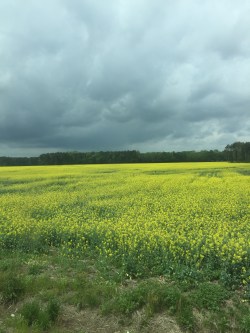
Storm clouds rolling in over one of our canola fields in 2015.
I love the scripture on the back of our farm shirts. 1 Corinthians 3:7 reads, “So then neither the one who plants nor the one who waters is anything, but only God who gives the growth.” This little patch of ground we’ve been given the chance to cultivate and use while here on Earth would be desolate and barren and all the nurturing in the world wouldn’t make it grow without His hand. It’s really no different from our hearts. Each day I pray you let the Lord be the gardener of your soul. Let Him nurture and love and protect you from the uncertainties of a world that is not our forever home. If you cast your worries and concerns on Him, He cares for you and loves you so much more than you can ever fathom. His love will grow in your heart and choke out the seeds of doubt and you will find joy in everything…because He is everything and through which all blessings flow!
The teacher in me must now give you homework. Over the next few weeks as you drive around keep a look out for a wheat crop. Watch the quick changes you’re going to be able to witness taking place in the plant…and more importantly, think about if that is reflective of your heart relationship with Christ!
Oh…and if you include a prayer that we won’t see a heavy frost tonight, that would be much appreciated!
 Farmer's Wife & A Southern Life